Monday, May 8, 2017

Campeche to Playa del Carmin

Riviera Maya
3500 miles (5600 km) thru Mexico in 35 days

Campeche to Playa del Carmen in 1 day

The roads from Campeche to Merida, to Playa del Carmin were very nice.  Divided most of the way and in very good shape.  The toll road started about 50 km east of Merida and ended just outside Playa del Carmin.  After the narrow, winding roads and high traffic from Puerto Vallarta down the Pacific coast it was a huge relief to drive on roads where there were no bottom scrapping topes (speed bumps) and you could actually drive faster than the speed limit of 110 kph (68 mph).  Remember this is Mexico where speed limits and laws of the road are merely a suggestion.  But we have noticed that road traffic on the Yucatan peninsula actually yields to pedestrians in a cross walk.  Also many crosswalks are on on top of flat top topes (we call them flat tops since the speed bump can be 8 to 12 inches high, that ramps up in about 2 to 3 feet, has a flat top that is just the length of the Prius' wheelbase before it ramps down again to the level of the road.
A flat top tope, these are the nice ones!  You can see it coming, has a nice ramp up and down and is only 8 to 10 inches high.

I (Gerald) have to be careful driving now, since I've gotten out of the habit of stopping for pedestrians (don't want to get rear ended!).  There are lots of road signs on the Yucatan that say "el peaton es primero" which literally translates to "the pedestrian is first" or as we would say in the USA, "yield to pedestrians".

The last leg was Mex 305D that drops down to Playa del Carmen.  There must have at least a dozen Monkey bridges across it.  Its all jungle and is a monkey habitat preserve, but the highway is a barrier for the monkeys.  So they string 2 steel cables on top of telephone poles across the road and attach a rope ladder (looks like like a ladder laying horizontal with rope rungs stretching between the two ropes attached to the steel cables).  Each pole at the end has 3 or 4 large ropes tied to trees in the jungle canopy that the monkeys use to get to the rope ladder.  The ropes appear to be 3 or 4 inches in diameter.  This allows the monkeys to scurry over the highway without having to drop down to ground level.  We drove through this area in the hot early afternoon so it was not surprising that we didn't see any monkeys.
On the beach at Playa del Carmen
Enjoying molcajete, a local Yucatan dish cooked in a stone bowl in a restaurant on 5th avenue, Playa del Carmen.

We have seen a few places offer mondongo, but its not the mondongo I so loved at Efrains restaurant in Lafayette Colorado.  Efrains used beef stew pieces simmered in a red sauce.  From what I have been seeing, the (Yucatan, Panama, Costa Rico, etc) recipes all use beef or pork tripe.  So cochinita pibil (a close second) and molcajete will have to do for us as we are note tripe fans!

Our room at the Grand Mayan faces the jungle so we get to hear and see some of the local wildlife.  The Chachalaca birds (Chachalaca) and pink flamingos (show birds for the resort as an ecological project, not wild) usually wake us up in the mornings.  If you think peacocks can make a lot of noise, you have never heard a Chachalaca - its not a large bird (skinny pigeon sized) with an amazing noise!   Several nights it has been cool enough to sleep with the patio doors open (on the second floor so we don't have to worry about critters coming in).  One of which is the coati:
Coati or Mexican Tejon,or Mexican Raccoon....
Now this poor Mexican Raccoon (what the staff here at Vidanta call it), has a name problem.  From wikipeida: The coati, also known as the Coati-Mundi or coatimundi, hog-nosed coon, Mexican tejón, cholugo, or moncún, Guatemalan and Costa Rican pizote, Colombian cusumbo, and other names, is a member of the raccoon family.

The jungle is really amazing to us since we haven't had a lot of exposure to jungle life.  When were were coming back from the Cirque du Soleil show, it was dark (about 10:30 pm) and we were on an elevated wood walk way with side railings.  We noticed some leaf bits moving down the top rail.  Looked closer and it was leaf cutter ants.  About every foot or two was an ant (about 1/4 inch in size) carrying a bit of leaf about 1/2 inch by 1/2 inch and empty ants going the other way.  We followed them for over 60 yards from where they came off a tree limb touching the rail to where they went down the 10 foot post to ground level.  We looked for them the next morning and there was no sign of them.  Since it can be rather hot during the day time, we suspect they forage only at night.

Some of the street art in Playa del Carmen.


Thursday, May 4, 2017

Edzna Archaeological Site

Now that we are in the area of Mayan culture, we took the opportunity to get out to one of the many archaeological sites.  Probably not the best place to be in 100 degree weather but we have to get used to it and it is going to get hotter, not cooler - if we want to do anything fun then we need to adapt to the heat ;)

This is mostly a pictorial blog today because the pictures tell the story (besides, I deserve some time off don't I?) - except to say that I have now fulfilled another bucket list dream.

Leaving town to head out to Edzna was an adventure in itself - these are two way traffic roads, not one way streets, but somehow we all get where we need to go.

You never know when you are going to find another church not what it is going to be like.

Enjoy the Mayan Archaeological site with us:  Actually since you won't have the mosquitoes, the heat and the humidity (sweat was pouring off us all the time we were there), I hope that you really enjoy this ;)


There were iguanas everywhere, it was like a little Jurassic park with all these tiny dinosaurs running all over the place - Iguanas are common all over Mexico but we have been more used to the bright green iguanas that mostly live in trees however these little gray and brown fellows dig tunnels in the ground


Notice how the rooms were built with smooth stone blocks on the inside and then covered on the outside with stones which often formed domes over those rooms.


I even found a snake - Ian, what is this?


But I digress ..


The 15 rooms on top of the North Palace seen above (looking like a set of bleachers) are believed to have housed administrative offices etc.

The city covered 25 square kilometers and once housed about 25,000 people.


Domed roof

Rooms in the Gran Acropolis

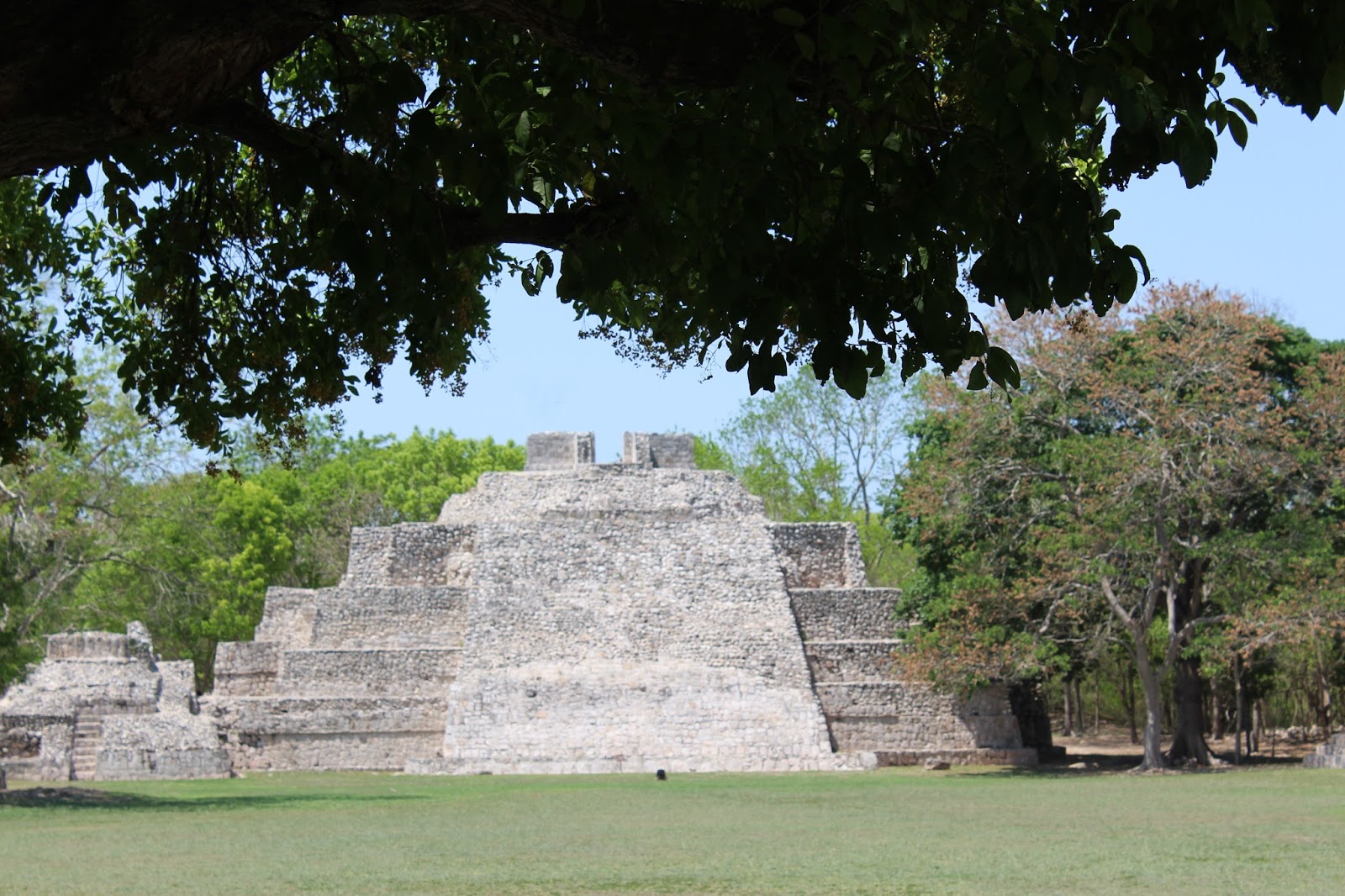
Gran Acropolis or Sun Point, a pyramid on top of a much larger pyramid substructure. 
Close up of the amazing bricks and one of the arches built into the Gran Acropolis.


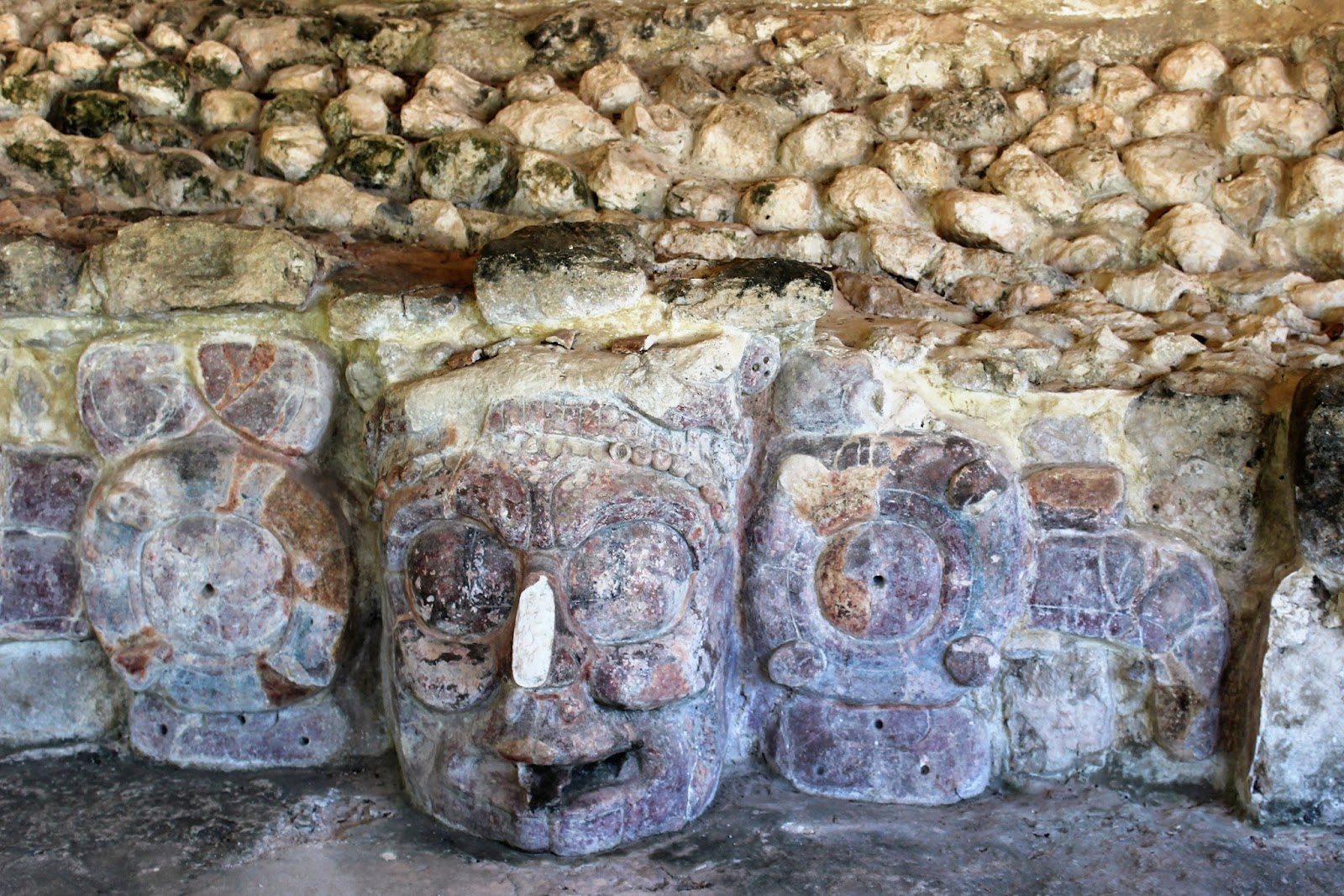
The Temple of the Masks was uncovered in 1988 and has two small masks that have somehow stood the test of time.  Since they are made of stucco, not plaster, their preservation is quite miraculous because stucco is a very delicate and fragile material. One mask represents and honors the Sunrise God and the other the Sunset God.


Need a hand up the steps?


While driving back to town, we thought about how we need to continue to look after the Prius - it has faithfully carried us so far already and we don't want the poor old lady to end up becoming a Mexican car, she deserves so much more.

Coatzacoalcos to Campeche

Journey from Coatzacoalcos to Campeche
At breakfast, Jesus packed up some pastries and fruit for the road for us and gave us a map and directions as well as reminding us that he would be available for work for us.  Wow, what service, we have never received attention like that before and we have made a friend already after only 1 month in Mexico.  We can only keep getting better from here.


A new autolavado (car wash) opened next to the hotel.  It was actually a basic automated car wash with hand finishing - this is the first ever automated car was that we have seen since arriving in Mexico and by the length of the queue on it's first day, I suspect that it is the first time than anyone else has seen anything like this here.  All other car washes are a couple of people under a makeshift awning hand washing cars using a bucket of water.  21st century has arrived in Coatzacoalcos.

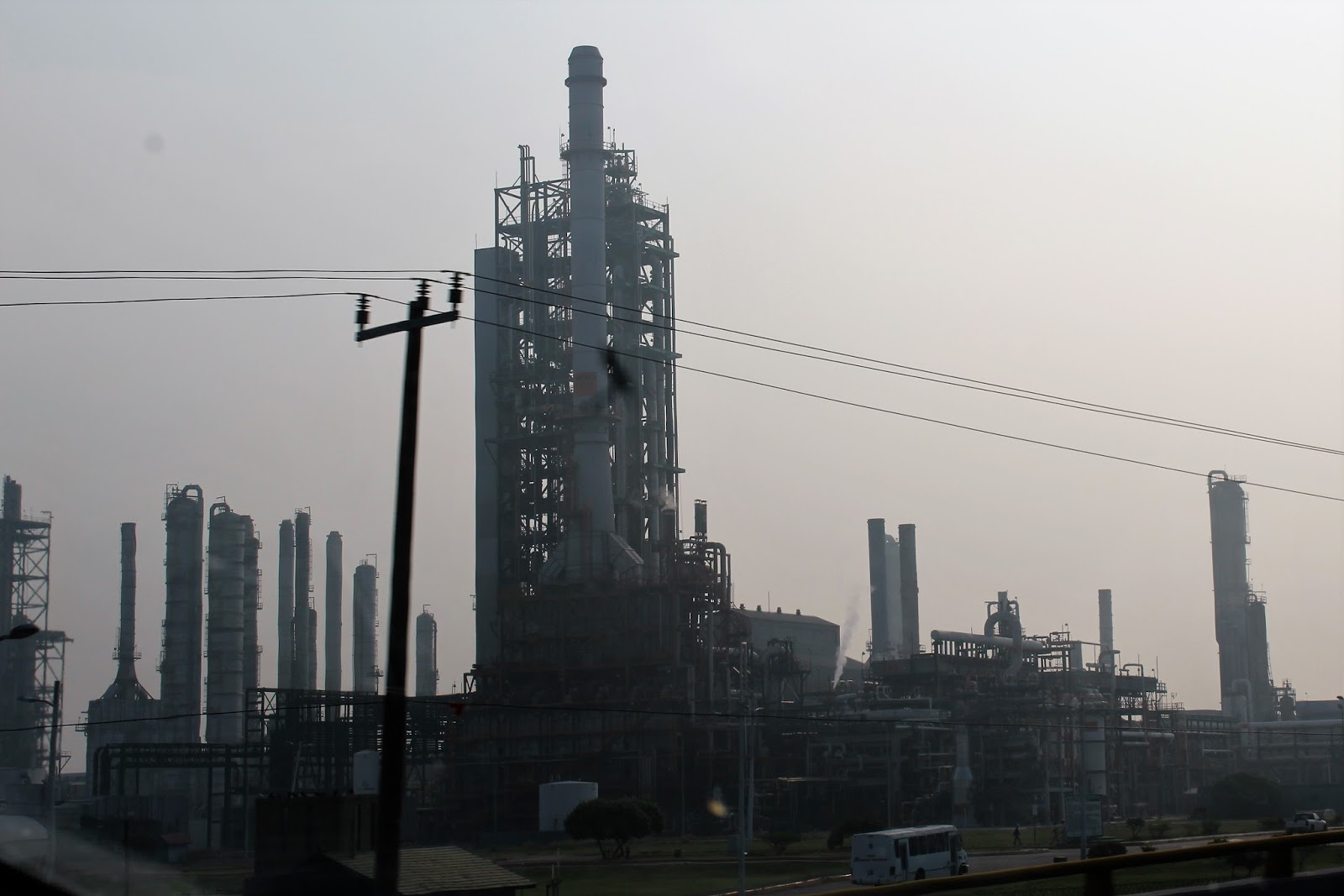
Leaving Coatzacoalcos (Coatza) shortly after 8 am, it was so misty that we could barely see - we passed by massive refineries and there were lots of trucks on the road - there is a railway line right next to the edge of the road as we passed over a lift bridge.


It is a very bad road in spite of the 11 peso toll which we think must have been for the bridge.  The road stopped suddenly in a couple of places with no warning and we had to had to change to the other side of the road.

Point of interest: a lot of taxis and most trucks here have brake lights that flash blue and red - very noticeable and we often though that there was a police vehicle ahead or behind us.  Our security detail always seems to be nearby though.


The heavy mist was with us all the way the Villahermosa but the land was very lush with thick green grass and wild bananas (or were they plantains?)  all the way.  When we got on the toll road about 50 km after Agua Dulce, the road surface changed to concrete and it was much better.

Approaching Villahermosa there were clean-up crews alongside the road filling black bags - we had not seen that before.

As we were travelling this long road today, we started reflecting about the people of Mexico and what we have learned/experienced so far.  We have already come to love Mexico and it's people and culture.  Sure there are good and bad points about the country as in all countries but  the people here are so genuine and mostly very friendly.  There does not seem to be any pretense, no materialism and no begging for handouts - there is always something offered in return for cash whether it is just a windshield wash or filling in potholes with sand.  Life is lived and celebrated.  In spite of the fact that the Mexican people have been stereotyped as loving sugar, we have found that everything here is much less sweet than back in USA - we really enjoy the non-sugary pastries.

Asta is a very pretty little town between the sea and a huge lake - lots of fishing by way of throw nets here and we saw fishermen fixing nets in their front yards.


At Ciudad del Carmen, the road goes right next to the sea, onto a point  and on a long bridge across the bay, crossing occasional narrow little barrier islands.  The airport was on one of those islands and we had to drive around the airport to pick up the road to carry on crossing the other islands and bridges.  After we crossed the 2nd island, the coast turned in to blue waters and white beaches with a distinctly Caribbean look to it.  There were were lots of lapas built on individual lots leading down to those beautiful white beaches and it looked like something out of a travel magazine.

Champoten is another very pretty little place with fishing appearing to be the main source of income.


Who would have thought that we would be seeing temperatures of 104 at the beginning of May - it is really hot and humid already, what on earth is summer going to be like?

All the many tolls that we kept paying for today actually only amounted to 293 pesos (about $15) which is really very reasonable considering how much all those bridges across the bay etc. must cost to maintain.

We arrived in Campeche around 5 in the evening and was very pleasantly surprised when we booked into our hotel (another low cost special from one of our plans).  The Castelmar hotel is in the historical center of town and is an old colonial building.  Our room is on the ground floor next to the pool - it has huge old wood doors, very thick old walls with arches around the doors, a very pleasant bathroom and it also has air-conditioning (oh the relief from the oppressive heat and humidity that we have been trying to adjust to) and it has wi-fi (so yes, I have to work on the blog again) but a very solid (read hard) bed.


After settling in, we went out to explore this beautiful historic town and to find some supper.  After wandering along some of the lanes, we settled on a little hole in the wall salad place.  One of the troubles with travelling for any length of time without a kitchen, is my serious craving for salads and vegetables.  We shared a big bowl of a really nice green salad and a large green juice - the bill came in at 120 peso (about $6 US).  Then we went off to explore some more lanes, the information center and the beach.


We went into the Cathedral off the main plaza and quietly sat listening to the service in process until we realized that we had inadvertently gate-crashed a funeral.  The bringing in of the coffin and the procession including the priests was our first cue.

Walking along the Malecon we saw lots of people walking, cycling and running - there were exercise stations set up with work-out equipment and there was quite a big group having what appeared to be Zumba lessons but I could not stay and certainly could not work out because of the terrible stench from the beach - I think that it is rotting sea weed that had washed up on the rocks but whatever it was, it had a very high sulfur content and I had to control my gag reflex so we moved off to about a block away from the beach.


Our timing was right and we caught a water organ display in a little plaza, I was captivated by Fleur Elyse so we sat on a park bench and caught the rest of the display, about another 5 more pieces, then went back to the main Plaza.


While sitting in the plaza we were greeted by some people and it took a moment to realize that they were the expats from Russia (or that vicinity) that we had met in the hotel Salina Cruz 3 days ago.  What were the chances that we would meet up again like this?