Tuesday, December 20, 2016

Trial Run to Saltillo, MX

We set out bright and early on Monday 19th December (Happy Birthday Angela) on a very cold, dark Monday morning. Well, cold for San Antonio as it was 27 F.  Sorry to our northern friends and family where is was almost 60 degrees colder!

We found out how little we really understand and are able to communicate in Spanish when we first got pulled for inspection at the border post at Eagle Pass - we managed to communicate that we are going to Saltillo for vacation.  Hurdle 1 - pass.  And as usual, the first turn out of the inspection area, Gerald turns the wrong way onto a one way street.  But without any one way street markings, there was no way to know it was a one way street.

Early in the day while it was still below freezing, we saw some field workers huddled around a little fire on the ground - we felt sorry for them as they prepared for a day of manually harvesting cabbages.  The cabbages were beautiful but do we appreciate what goes into getting them into the store for us?

The roads between the border and the the immigration office (maybe 20 miles past the border???) were busy with a lot of truck traffic.    We encountered no issues at all other than the occasional horse or cow alongside the road.  It was surprising how good a shape the roads between cities were.  Much better than we expected.

The process at the immigration post was quite difficult for us because we did not understand the Spanish being spoken to us (at least not enough of it) but other people would help us when they saw us struggling.  Really everyone was nice and friendly and helpful and it never hurts to smile, say please and thank you and "hablas mas despacio por favor" (speak much slower please).  It is necessary to have copies of driver's licence, passport AND car registration so we went from the first person who checked everything, sent us over to the bank to pay with instructions to return to him.  However we didn't think that we had copies of the car registration so we had to go back to him and buy a photocopy (of course we actually did have copies all along).  You have to pay the temporary import permit for the car and also pay for each person to be allowed to enter into Mexico.

Once we passed hurdle 2 (more difficult than anticipated) we were on the open road heading for Saltillo. We only ended up on one toll road and that was on the outskirts of Saltillo, before that it was smooth sailing.  We passed areas of housing that were new, with tiny little block houses, all identical, all shoehorned into tiny spaces.  Of course we also passed many of the more expected run down places but also some absolutely beautiful mansions and some good looking ranches.

A lot of the way the roads were pretty quiet and we were very surprised to see 'retournos' (turnarounds) in many places on the highway - like having turnarounds on our interstates instead of those 'emergency vehicle only' turnarounds.

Somewhere along the line we stopped at a filling station hoping to use the restroom and found that we needed 5 pesos each - we noticed that pepsi was really cheap and we needed the caffeine so we bought a 500ml Pepsi (8 pesos or about 40c) and as the lady gave us notes for change I actually asked her "quiero dinero para los banos" and she gave me two 5 peso coins in the change - strike 1 or is that 2 or 3 .. woo hoo we can do this - at least in some cases.

Road signs get very interesting and we need to do some research on what some of them translate to but the pictures are pretty much universal.  In one town we drove through, there were the neatest traffic signals - they were oblong led lights that had the word Alto (stop) when red and Siga (go) when green or became directional arrows when green - The green lights flash briefly before turning to amber warning that they are about red and these lights  and amber oblongs could be seen from far away.


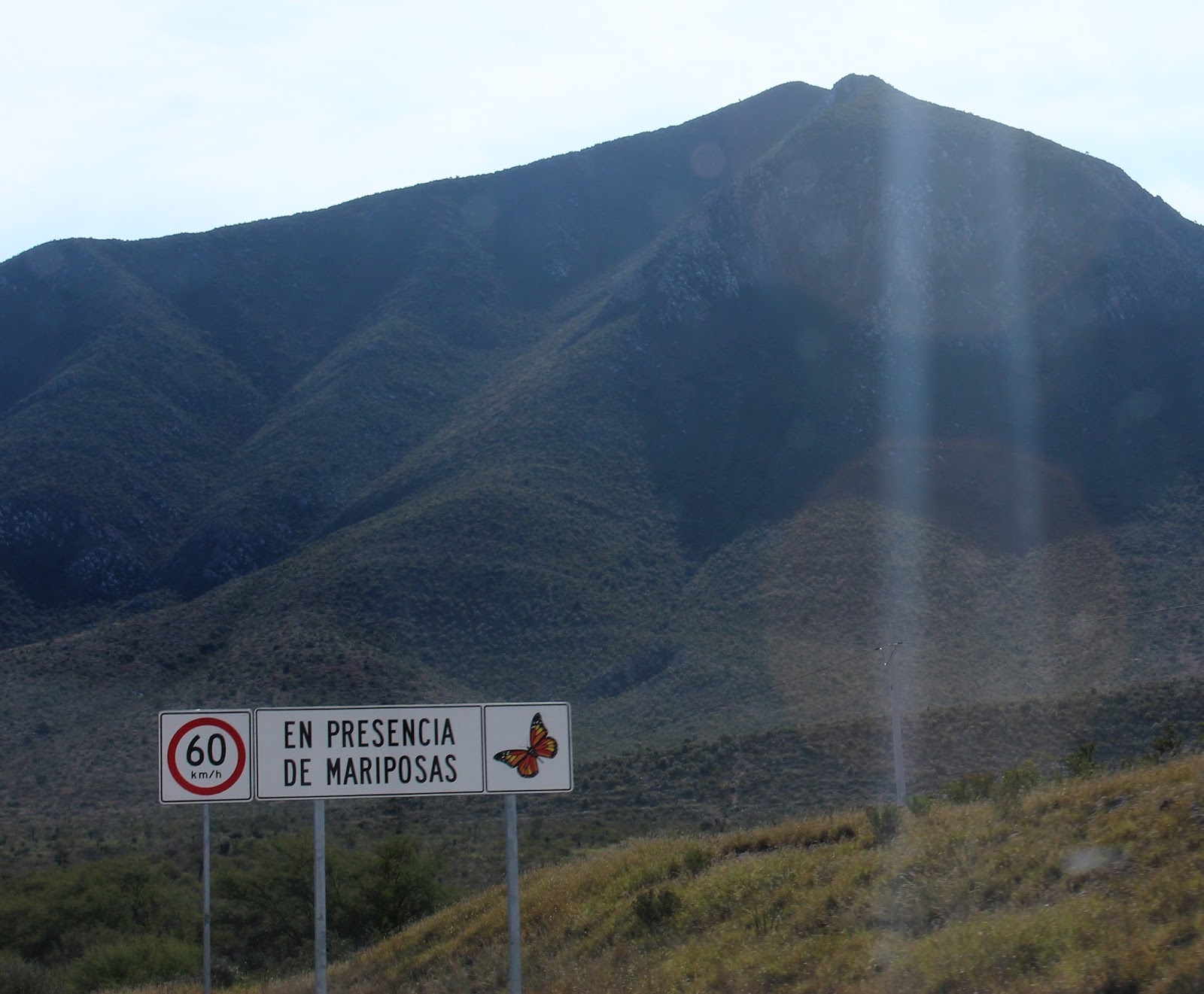
Where else do you see the speed limit reduced from 100 kph to 60 kph when there are butterflies present (remember the Monarchs migrate to Mexico for the winter).
In the Presence of Butterflies 
Not only were there pedestrian crossings (with no markings on the road surface) in all sorts of unlikely places, but we had to watch out for the bear crossings as well.


We arrived in Saltillo about 3 pm and we drove around one way streets wondering if we would every find out way to the Airbnb place but eventually we navigated through the traffic and chaos and arrived at the security gate of the complex.  Hurdle 3 - the guard did not understand us and we did not understand him.  We drover around inside the walled and gated complex and it's maze of one way streets.  Even though we had a map we still got a bit lost and ended up being stuck in the exit road and had to leave.  When we got back around to the entrance the guard was almost as confused as us and I was 'mas de un poco confusa'.  While all this was going on, our bladders were complaining bitterly and we decided to forget about trying to get the residents key and just get the heck to the apartment and 'el bano'. We found it quite quickly, managed to get the code into the lock box and get inside.  Hurdle passed.  The next hurdle was to try to figure out the WiFi and hot water in the apartment and to get our new phone working so that we could call our host and find out about the residents key.  We walked to OXXO (convenience store) which was conveniently very close to the apartment and hit the next language barrier hurdle.  We managed to buy the 149 peso ($7.50) SIM card for our phone (we had bought an unlocked dual sim card BLU phone in Best Buy for only $89.99 on Sunday before we left) but the real fun started when we tried to contact TelCel to activate the SIM.  This ended up a 4 way conversation with the very helpful lady who works at OXXO, Gerald, the person on the phone at TelCel and me - this was teamwork as you have never seen before.  I don't know how Gerald did it but somehow he managed to give the answers that were needed over the phone while I answered the question about his date of birth and read the phone number to the TelCel person. (Gerald needs to bone up on his spanish numbers!)  It was very frustrating and humbling but also a very interesting experience.  I have always been patient and tried to help people who are obviously having a problem trying to communicate when they cannot speak English but now I will have just a bit more patience and understanding - it can be quite scary and very difficult to get things done when you cannot communicate in spite of having studied the language.  So many people deal with these hurdles every day of their lives and we are going to be in that position ourselves now.  Somehow it feels as though the language lessons we have been working through are not really preparing us and we need to practice even more and learn so many more words than we already have.  We also found out in OXXO that it is easy to fall prey to the vultures who recognize you as extranjeros who may be vulnerable - one man was talking away to us about how he could look after us, he said he was "well with the police" and since our white color gives us away as tourists.  I thanked him and we left the store quickly.

Day one is coming to a close and we are tired, still cold and hoping for a good night's sleep, chance to get over the feeling of inadequacy that these tests have given me today.  I know that we can cope with all that our future is going to bring, it is our choice to put ourselves in this situation, to explore and discover - maybe explore and discover ourselves, our relationship and our abilities as much as the places that we will be visiting.

Tomorrow is promising to be warmer and sunnier than today and I am looking forward to going to the Plaza de Armas and the Cathedral as well as the Museo del Desierto in the Parque de la Maravillas.

Wednesday, December 14, 2016

Road Signs in Mexico

Oh so much Spanish/Mexican still to learn if we are going to survive the roads !

http://consejo.bz/mexico/signs/mex-signs.html

This is a very interesting site explaining road signs and the all important tip that if you see stones or fresh cut branches on the road, there is a breakdown ahead - or at least there was recently and the driver forgot to clear his 'road sign' away.

Friday, November 25, 2016

Getting Ready for a Trial Run

11/25/2016
As the year starts drawing to an end, our preparations heat up.  Soon the months will turn to weeks and it seems as though we still have so much to do but there is so little that we can actually do until closer to Rday (Retirement day) .  Right now we are concentrating on transferring all our knowledge at work, ensuring that we can hand over and everything that we handle will be capably covered after we are gone - that is a big responsibility and the logistics are not always so easy when you have to get everyone lined up and available in order to pass on the knowledge and understanding of so many years.  Thank goodness for documentation and collaboration services such as O365.

December is going to be hectic with another 2 weeks scheduled in California for work but as soon as we get back (December 17th) we will repack our suitcase and head out for Mexico on December 19th (Happy Birthday Angela!!).  When we get back it will be 1 day before Christmas - how is that for a chockablock full month?

We have our Mexico auto insurance, copies of drivers licenses, car registration and title, dinero is in our hands, map of Mexico was just delivered along with the soft collapsible backpacks that we got on sale.  Accommodation has been booked and confirmed by way of Airbnb (where else can you get a whole apartment too big for your needs for $100 for 4 nights?).  We have a super host who happens to live in Austin but is being so helpful already with tips and ideas for us.

Along with the delivery of our map etc. we even got tips from the delivery driver - he said that we can get a phone in Walmart with coverage in Mexico - guess where we are headed this weekend.  This is going to be our only full weekend at home before the chaos of December so maybe we will also hit REI to see if they have any summer clothing on super-sale.  They have those nice light, quick dry clothes with little zip pockets that are so handy for travelling and hiking.  I have a pair of REI shorts that I bought  before I even met Gerald and they are STILL going strong - I have been drenched in one of our incredible TX rainstorms a couple of times and they dry while finishing a hike wearing them!

Can you feel the excitement mounting?  Stay tuned for more fun and adventures Pattyn style :)
three and a half months/15 weeks and counting.

Wednesday, November 16, 2016

Retire Overseas Bootcamp in Las Vegas

November 10th 2016

We left home around 4:30 am after coping with the blocked drains and dishwasher again it was good to get going.  First flight was SAT to LAX and then on to Las Vegas.  We arrived in Vegas about 45 minutes before the shuttle left for the hotel - all the airport staff were very helpful as we struggled to navigate our way through the crowded airport in a hurry and didn't know where to find the shuttle.  We picked up a sandwich in the airport and and managed to gulp some of it down before we boarded the shuttle but were able to finish it on the bus.

Conference day 1:  

Everywhere looks great and the enthusiasm of the correspondents is catching.  This was a kind of country speed-dating session and the overall theme that came across was that of a healthy lifestyle, low cost of living and great, very affordable health care.

Mexico Infrastructure is good and high speed fiber internet and a phone plan (that includes free calls to USA) is less than $20 a month and rental accommodation can be easily found for around $500 and up.  A permanent resident visa can be obtain just by proving assets of $75,000 with no need to prove income.

Costa Rica In the Central Valley the temperature never gets above about 80 and gets down to about 60 at night.  Living in the central valley is cheaper than living at the coast and rentals can be found for about $500 and up. A Pensioner Visa can be obtained with proof of income of $1,000/month and entitles you to government health care. The north coast is a dry area and has many sunny days.In general, a good living can be had here for about $2,000 a month.

Malaysia  This is an exotic island but humidity may be a problem.  The cost of living here is about one quarter of what it is in USA.

Belize  This used to be # 1 on my list, this is where I started this research adventure but with annual rainfall of between 53-77" and mean humidity of 83%, it is off the list for a possible permanent living/retirement.  However we still need to spend some time here visiting and exploring, especially the Mundo Maya ruins and villages as well as doing some snorkeling down at the beaches.  The mix of heat, humidity and mosquitoes would not be a happy life for us.

Nicaragua This appears to be the cheapest country with a great outdoor lifestyle - It has been likened to living in the 50s in USA.  Nicaragua has manged to retain its culture but city living can be noisy - think about all the festivals (we could get used to this and definitely enjoy the festivals?).  Here life seems to be all about nature.  There is a choice of temperatures according to location and generally humidity would be about 57% - not all days are rainy in the rainy season and there are still a lot of sunny days.

Colombia  Not a country that had been on the list until now.  All climate options are available, just choose the place with the climate that suits you.  Life is family focused and the cost of living is low with many different lifestyle options - can you believe that the WHO lists it as # 22 on the world's best health care list with USA being # 37?  Up in the Andes, temperatures vary between 55 and 80 and Medellin has been shown to be safer than Las Vegas and there is a healthy outdoor lifestyle

Thailand  HOT all year round with temperatures in the 80s in winder and high 90s in the summer.  Health insurance sots do not seem to be very reasonable compared to the other countries we are investigating.  Although there are some interesting points, it is more on the expensive side and the requirement for a visa is $1,842 a month.

The general feeling after day 1 is that we are looking at a healthy outdoor lifestyle, cheap cost of living, affordable health care and a good family focused  culture.

That evening we walked around the casino and found lots of options for supper, ranging from expensive fine dining down to very affordable fast food type places.  We settled on supper in 8 Noodle Bar which had a very nice atmosphere and really inexpensive food.  I had Bimibap which was on my 'want to try it' list ever since I saw it on Master Chef once (it was healthy and really enjoyable, all that I thought it would be) and Gerald had BBQ short rib steamed buns, very nice.
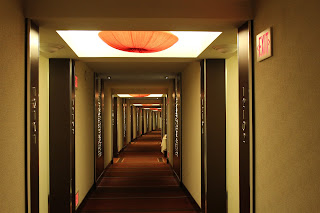
Hotel Corridor


Entrance to Hotel Room

Day 2

Ecuador has warm, kin, gentle people with affordable rents and a temperate climate.  It has a constant 12 hours of daylight every day, is on EST and has no daylight savings time change ! (bonus # 1).  There are many lifestyle options to choose from so we need to research the different climates and lifestyles in more depth.  Guayaquil is hot and humid so not the location for us.  In Cotacachi an example water bill is $3.47 and electricity is less than $20 because air conditioning and heating are not needed - love that!  For over 65's there are lots of discounts.  Although imported goods are more expensive, they do now have local peanut butter (so many expats hated not having their peanut butter) which is actually better (read natural, healthy), now we are REALLY happy about Ecuador.  Ecuador has a sense of freedom, with old fashioned values and a slow pace.  I is a place where you take care of yourself and your own possessions - you don't sue just because you trip over an uneven sidewalk (woohoo!), however it is a loud (and vibrant) society.

Panama The Chiriqui highlands (Boquete) is more remote and is in the dry arc.  Healthcare: doctors spend time and have time to really care about their patients - the local clinics are good for everyday ailments.  The Balboa is equal to the USD (Bonus!) and the Pensionado program offers a lot of benefits (another Bonus).  For a resident visa we need to show an income of $1,000 a month and it is easy to obtain.  The downside though is the weather, it is HOT (88/68) and HUMID!  Coronade is in the dry arc with temperature 80/68 and Boquete is in the highlands with temperatures about 10 degrees cooler.  I think that noise and trash may be a problem - would we relax into this type of slower lifestyle and accept the downside issues?  Again, we need to experience life there for ourselves, in different areas.  

Healthcare:  

Must pay in full at time of service and small local clinics may only take cash - however, the costs are 25-50% of what they are in the USA.  Health insurance rates rise with age and O65 may not be accepted.  Private insurance is usually only available with a resident visa.  In Belize, Colombia, Ecuador and Mexico we can get a local public insurance but would have to have a resident visa.  Full time expats are exempt from the Affordable Care Act so I need to calculate whether it would be cheaper for me to pay for Medicare part B and part D or pay the fine - paying the fine for Gerald for that first year appeared to be the cheapest option but buy into the plan with our reduced income (1/4 annual salary as we will only be working for 3 months of the year) could end up costing us only 50% of the fines. Looking at the affordable care act and trying to figure this out is a nightmare, it is very confusing especially putting my Medicare eligibility and the fact that will be working for 3 months of the year. This is going to take a lot of research and we need to start working on this.

Ecuador IESS (national health care) has no age limit and pre-existing condition restrictions - can apply online but must be a resident.  The cost of the plan is $65 for the primary member and $12 for a dependent.  It is necessary to pay for 3 months before being eligible to receive benefits and you cannot chose your doctor.  It is necessary to realize that since you cannot chose your own doctor, you may be assigned a doctor that does not speak English; appointments may take a long time to get and hospital rooms are shared.  However, the government is committed to providing top quality care for all citizens and you can chose to buy your own private catastrophic coverage.

Panama insurance companies do not accept patients over 65 - We need to look into BUPA and WWM International insurance, alternatively local hospitals have membership programs which give discounts etc.  You are never more than about an hour from a good hospital, also dental costs are usually out of pocket and a very high level of care is provided.

Columbia has very high quality, low cost health care that is easily obtainable.  EPS (about $75 a couple) is a public health plan; anyone with a cedula (resident visa) can apply BUT maximum 1st enrollment age is 60!  Private plans often require having EPS and they are not required to accept you. In Columbia, there is not so much need for prescriptions or referrals.

Costa Rica is the center of medical tourism.  There are good clinics and hospitals throughout the country.  CAJA (CCSS) is Costa Rica's national health insurance system and is available to legal residents only but tourists can use the CAJA in emergency situations - refer to www.ccss.sa.cr.  There are no pre-existing condition or age limit restrictions.  The best care is in San Jose.  CAJA care usually means wait times, private facilities are quicker and still affordable with international departments, pay cash.

Malaysia is VERY affordable so paying out of pocket is possible.  A regular doctor costs $16 and a dental checkup is $12.  Example, a knee replacement all in cost the speaker $1,600 cash.  It would be very feasible no matter where we are, to take a vacation to Malaysia if surgery is needed.

Renting 

is obviously the first step to ensuring that the right place is chosen before buying but it also gives the freedom to move around as well as to check out the real estate market "boots on the ground".  Rentals are often furnished but check what you will be getting, sometimes furnishing is very sparse and you cannot assume that you know what you will be getting in the way of furnishing and utilities etc.  Feel free to negotiate - you may also get utilities included but rarely electricity because it can be expensive if air-conditioning is needed/used.  Airbnb; VRBO.com and even Facebook are useful resources - try listing a wanted post on FB saying what you want and what you are willing to pay, then stand by for offers.  When buying property, in most countries you have the same rights as local property owners.  Remember that property taxes are usually only a couple of hundred dollars A YEAR !

Property buying do's and don'ts:

Always buy in an area of future progress and get in early.
Don't assume that it's the wild west - there are still permit needs etc.
Do buy from the right developer, check that they are established in the local market, does he own the land or what are the plan for paying off the loan and are there sales already.
Don't pay any money or sign a contract without an attorney.  The attorney should be trusted, knowledgeable and bi-lingual with no connection to the seller.
Always buy title property (freehold or fee simple) and check that you can legally own it.
Don't take things for granted especially water and never pay in full up front.
www.pathfinderinternational.net/DD.pdf

Ecuador Visa:

Need passport; state and Federal background checks; letter verifying income; a trusted lawyer (I have the card of a lawyer) who will be able to apostille and translate documents when in Ecuador.  Do NOT need birth certificate.  Background checks are valid for 180 days; car insurance is not necessary but they will start asking questions if still driving on USA plates after 90 (or is it 180) days.

Nicaragua:

Hey, geothermal electric power, now that is a plus for us ;) Nicaragua has a low population density.  The number of women in Parliament is 40%; the retirement income requirement if only $600 a month (now that is a GOOD indicator of the low cost of living here).  The weather in Managua (capital of Nicaragua) is like the weather in San Diego; it has big city life and the best health care but is noisy and has a lot of traffic.  Leon is a colonial, university city and is 25 minutes from the beach (does that mean it is humid?), housing is cheaper here than in Managua.  Granada is also a colonial city but not yet refurbished like Leon, it has good clinics and hospitals.  San Juan del Sur is a beach town - it has a local clinic only but a hospital is coming.  Matagalpa is a cool mountain town with waterfalls and lots of good hiking.
Nicaragua does not have a regular medical insurance plan but vivian pellas hospital plan costs about $25 - $6- a month, giving 40% discounts.  Really though insurance is not needed because it is so cheap.
Rentals of a 2 bed condo range from about $400, furnished with wi-fi, to as high as you want to go - you need to be feet on the ground to get the best rental opportunities.
Tourist visas are valid for 3 months and can be extended for 3 months but border runs are OK here.
Requirements for the Pensionado visa program are proof of income of $600 a month, a health certificate (including mental condition and attesting to no communicable diseases), police record, birth certificate and passport photos.  ALL DOCUMENTS NEED TO BE APOSTILLED.

Day 3

Check that the credit cards that are going to be used don't have foreign transaction fees.  It is not looking good for our existing credit cards so we need to do some more detailed research in this area.
We need to consider keeping Gerald's Credit Union account as a reference for if we want to get a foreign bank account.  Can we xoom money to an Ecuadorian bank? Yes with fees ranging from $18.99 for $1,000 to $39 for $2999.

Taxes and Financial Stuff

We would need to file FBAR if having more the $10,000 in any/all foreign bank accounts.  FATCA must also be filed at the same time.
How do we show expat status when travelling - research item.
$101,300 of foreign income is exempt from tax if we are out of the USA for 330 days of the year and the same applies to not being liable for Obamacare.

Research Item: Check to see how H&R Block software handles foreign income.

There are currently only 2 bank\s in Ecuador that accept Social Security deposits.  We may need to use a foreign exchange broker if we want to transfer money into an Ecuadorian bank (think  about those great CD rates).

Everbank are a direct (online) bank with yield pledge accounts meaning accounts will stay in top 5% - diversify 10% of assets outside of USD.  They have standing wire instructions, will trade @ <1%, you have the foreign currency in your account and then they will wire it to offshore account when instructed.

Medicare: if living overseas you can drop coverage of Part B Medicare but would need to pay a penalty of 10% when/if you return.

Most financial transactions such as opening a bank account, are on a personal basis in Latin America and a reference (though not necessarily an intimate one) is often needed, even if it only says that you are known, are a real person and seem to be nice.  Signatures and name spelling are important - they need to always be the same (preferably the same as appears on your passport).  There is more formality than we are used to regarding signatures.

Bits and Bobs of Information:
It is important to have a good legal resource on the ground to help with transactions and visas etc. Visas and driver's licenses can usually be obtained within 60 to 180 days.

Take a look at hcch.net for the convention regarding apostilled documents.  Latin America loves paperwork so the more documents that we take with us the better, even if we never need some of them.

For virtual mail and even street addresses, theupsstore.com; myus.com and earthclassmail.com look to be good resources.

Skype looks like the best option for us for phone/communications.
Netflix, USTVNow.com; UFreeTV.com and also Roku are worth investigating for TV.

Brush up on the metric system and conversions.

We can drive up to 4 years in Mexico on our home plates but will need to come back to Texas each year to get the car inspection and plate renewals.

Duolingo.com is another good resource for language but right now we are loving memrise.com (free).

It would be a good idea to have a full health checkup before leaving USA and renew vaccinations, particularly Tetanus, Diptheria, HEPA and Typhoid.  Some countries are considered a Yellow Fever risk so need to be sure that we understand which those countries are before entering Costa Rica.

Yes quite a lot of information and we had so much fun - here are some of the photos that I took from and in the beautiful Red Rocks Resort where we were staying.  Mostly sunrise over the strip as seen from our hotel room :)

The start of another beautiful day


Overlooking the strip at night


ECUADOR:  Is about the same size as CO and most expats are in:

Cuenca (8,000’) – a city of about a million people with malls and supermarkets and cultural activities, just outside of Cuenca is Yuencalla valley.  Cuenca has stunning architecture and is a UNESCO World Heritage Trust site with a very European feel.

I took the opportunity of chatting to a Cuenca local and she told me about the beautiful weather with lovely spring like days (never over 80) with cool fresh mornings and evenings.  She said that they do not use hear or air conditioning and that there are 4 rivers running through town which is why people say that the town is so energizing.

Quito (9,350’) is a vibrant big city but can be congested with traffic – however, taxis are cheap.  Just outside of the city are valleys with a lower elevation and very upscale homes.
Cotacoch (8,000’) is near the Colombian border with a small town feel, very safe with a close knit community.

Vilcabamba (4,500’) is more difficult to get to and has a lower elevation – it is very small and very beautiful and is known as the valley of longevity.
Salinas is a coastal city, the westernmost city on mainland Ecuador.  It has high rise condos all along the beach but behind that are the usual low rise buildings.

Olon is a small beach town with a good expat community in an up and coming area close to the hippie surfing town of Montanita.

It is a good idea to take prescription medications on your travels and to ask a pharmacist what they can get for you.  It is no longer necessary to return to USA for all your favorite products either.

Don’t plan on getting mail in Ecuador – it is a good job that I have been working on getting mail stopped or sent online only and I am research for the right virtual mailbox.

Residency is easy and no special visa is needed in order to rent or buy property.  A Tourist visa (free) is valid for 90 days and is only given once a year. A Pensioner visa is based on pension/social security income with a requirement of $800 for the primary and $100 for each dependent or a CD purchased in an Ecuadorian bank to the value of $25,000 for 3 years – but the interest rate is high (7 to 10%).  Also needed are a criminal background check (FBI and state police), Marriage certificate.  These must be sent to an attorney and be apostilled.   Senior benefits are 50% reduction in domestic airfares, discounts on public transport, entertainment, taxes and utilities.  An attorney (to be provided with Power of Attorney) can open a bank account on your behalf in order to buy a CD if needed while not yet in Ecuador – since the currency in Ecuador is the US Dollar, there is no concern about any devaluation (BONUS!).

The Government fee for a visa if $500 but $50 - you must stay in the country for 9 months of each year for the first 2 years.  After that you would only face losing residency if you were not in the country at all during a 2 year period.  Any money leaving the country is taxed @ 5% so be careful about the seemingly great interest rate if you are no planning on staying and spending both the capital and interest inside the country.

MEXICO:  English is spoken in the areas of San Miguel, Lake Chapala, Puerto Vallarta; Guadalajara and along the Riviera Maya.

Lake Chapala is about 52 miles wide but it is shall and is muddy up close.  It does give nice lake views though.  Chapala is spring like year round with only a little humidity – I have been waiting to hear those words but (and there often is a but) it may be a bit too American compared to what we are looking for.  Rents run from about $500 but more commonly $700-$900.  There are a lot of expats in this area and this makes it very easy to assimilate.  It is about an hour to Guadalajara which is the medical hot spot.

San Miguel de Allende also has a very large expat community and is one of the most beautiful towns – there is a wide variety of dining options at a wide range of prices.  High temperatures range from the 70s to the 90s and it can get down to freezing – rentals look more expensive than in Chapala ($1,000 is common).

Puerto Vallarta (where we have a one week vacation booked) has been an expat destination for more than 60 years so it is not so ‘local’ anymore.  A furnished rental near the beach could be found for about $900 but again, $1,000 is more common.  It doesn’t sound like the best place for us.

Riviera Maya has the most beautiful beaches but I think that it will be too touristy and miss some of the Mexican culture that we are looking. 

Guanajuato in the colonial highlands is a university town with about 10,000 students and has a much smaller expat community.  You would need to speak some Spanish to get along here.  Rentals here are from about $450 but being a university town, there is a shortage.  This place is quite unique in that it is very walkable because traffic is routed through underground tunnels instead of through the city.  It is also a UNESCO World Heritage Site with charming colonial era architecture and is in a very picturesque valley with mountains all around.

Visas can be valid for 180 days and you can drive a foreign plated car here.  A temporary resident visa can be obtained for up to four years with proof of earnings of $1,100 (+ $365 for dependent) or with just proof of $18,260 in the bank (does not need to be in a Mexican bank).  Public health insurance premiums increase with age.  For those over 80 the cost would be $325 a year but pre-existing conditions are not covered.

Don’t forget to let the banks know that you are travelling – we have already using online bill pay which will help.  What about foreign exchange fees on credit cards – probably better to use our “no foreign exchange fees” debit card to draw cash rather than use credit cards that will attract foreign transaction fees.  We know of people that successfully use only cash in some Central American countries and do not have a local bank account.  We do need to spend about 4 to 6 months in each destination in order to get to know it well enough to make a decision about whether or not it is for us – this will be interesting because we will also need to come back ‘home’ in order to get our car inspected and the plates renewed.

One of our contacts (Jason Holland) talked about how he drove throughout Mexico with no issues, using the toll roads and not driving at night (you never know what is going to be on the road or if you are going to hit a pothole at night).  Car insurance seems to run at about $500 for 6 months and we can buy a permit (TIPS – Temporary Import Permit) for the care at the border for about $400.  We need to keep our driver’s license and plates valid so we need to keep on top of those renewal dates so that we don’t forget.  This also means that we need to do even more research about getting an address or how we are going to renew our USA Plates.

Costa Rica only accepts a Visa type credit card and this seems to be the most commonly accepted type of credit card.

Another tip for a good travel in Mexico resource is MexicoMike which has driving maps and road logs.  We need to keep our driver’s license and plates valid so we need to keep on top of those renewal dates so that we don’t forget.


We also need lots and lots of copies (50 were suggested?) of car Title, Registration, Driver’s License, Passport and some copies of a healthy bank statement in case there are questions about whether or not we can support ourselves while staying in any of the countries that we will be exploring.


Saturday, August 27, 2016

Today we went to Mexico

8/27/2016
Pretty much on the spur of the moment we decided to go to Mexico today - Gerald is out of allopurinol and it is going to take weeks for him to get the doctor appointment that is necessary in order to get a new prescription.  Not only that, there will be tests and all the related time and expense, so we decided to take a quick trip to Mexico where it can be bought over the counter in a local Farmacia.

It was such a beautiful drive - the roads were relatively quiet, especially once we left San Antonio. This year's second spring is arriving and both the Crepe Myrtles and the Texas sage is blooming beautifully.  The first spring earlier this year brought a multitude of blue, yellow and white flowers growing along the edges of the roads but this second spring (which seems to be brought on by the rains in late summer) brings with it broad swaths of Texas Sage alongside the road and field upon field of beautiful blossoms beyond that.

We were going to walk across the bridge into Mexico as it was only a couple of miles to where we knew of a Farmacia that has what we need, but decided that finding parking in Del Rio was not easy and anyhow we wanted a trial run to see how complex (or simple) it is going to be when we cross the border next year for the real adventure.

This turned out to be a good decision because it was a breeze, we just paid the toll on the USA side (a whopping $3.50 for the car) and once at the Mexican border post, got into the 'nothing to declare' lane and drove straight on through.  Of course this does raise the question about how/where are we going to get our Mexican car insurance and pay the necessary fees and get our Visado, but that is for another day, today was easy and fun.

The first big surprise was that our GPS (with only USA maps loaded) still actually worked in the heart of Acuna.  The second surprise, once we parked (much more easily than expected once we were off the 'main' road), it was much cleaner than we expected and there was a man busy sweeping the sidewalk where we wanted to park.  I was able to communicate with him enough for him to let me know that it was OK to park where we were - it looked confusing to us because there are a lot of little bumps built into the road, not painted lines demarcating parking spaces - apparently as long as you park anywhere within those little bumps you are OK.

So we parked just around the corner from the Farmacia that I had picked out this morning on a google map (having of course researched it and seen that they had what we need, at a reasonable price).  After a few moments of stage fright we started practicing our Spanish (thank you Memrise!) and managed to communicate what we were looking for (it also helped that I had written down the Mexican version of Allopurinal which is alopurinal, along with a brand name).  The next test was figuring out how many US Dollars the price came out to be.  At the end of our little 'conversation' we ended up walking out of Farmacia Del Nino with a 120 day supply for only $5.75 !  At the end of the day, 9 gallons of gas and $5.75 was an absolute bargain for a day 'abroad' in Mexico, lots of fun and education, amazing experiences and exorbitant doctors bills and lab tests etc.  What a bargain!
From here we drove around exploring and found that the streets are narrow with cars parked facing in both directions on either side of the road.  Look out for poorly maintained roads and sidewalks but mostly, there are a lot of one way streets that do not have any one way signs (that we could see anyhow).  We ended up driving the wrong way down a one way street and were kindly waved across by an oncoming motorist so that we realized our mistake.  Not a horn was to be heard, no rushing motorists, no road rage, just patient acceptance.  However, if I mention that there does not seem to be much of law enforcement and we saw at least one beat up car with Texas plates and an expired licence sticker (actually it expired in 2013) driving around, I guess that would explain the patient acceptance.  It doesn't really matter?

Our business completed, we drove and walked and generally explored - I had read about a supermarket called Gutierrez who farmacia had great prices, so we got Naggy (the GPS) to take us there.  After an adventure of several blocks, we finally ended up there and went exploring in the supermercado - this time we could not quite get clear about the price with the assistant and it sounded expensive so we left it - we will be back shortly before Gerald's supply runs out (we had bought the last of the stock that Farmacia Del Nino had).  We had great fun looking at all the strange and wonderful fruta y verdura en pastries and tarta.  The fruit and veggies actually didn't look too good - even though all the prices of groceries were very much better than here in the USA, the quality was poor - probably because all the good stuff is shipped to us and we get great quality here in TX at very reasonable prices.  Again, we had a lot of fun and feel that we learned the very small beginnings of life in Mexico.


One big lesson that I learned there, is look before you enter the rest rooms (banos or servicios).  Once I got into the toilet stall I realized that there was no paper, not even a holder of any sort for paper, so I tried the next stall but it was the same.  I left and was going to go to the car for tissues but as I looked around waiting for Gerald, I saw some people going into the bathroom but stopping first and taking paper from two big dispensers on the wall at the entrance to the area where the rest rooms were.  Now I know next time, look outside before going inside !

By now, it was time for lunch so we drove back into the central are where we had previously been - again, going around many back roads discovering lots of different architectural styles (?)  Naggy may have the map of Acuna but it is obviously way out of date and anyhow, only the major streets in the central district actually have name signs.  I am also very sure that there have been many renaming exercises between when our map was created and now.

We saw some fascinating sights and looking back, it was much quieter and cleaner that we had expected.  On our way to finding a local eatery that looked clean and inviting and frequented by locals, we saw the most amazing shoes (oh my those heels are like stilts) and of course the fantastic occasion dresses that looked like wedding cakes or something from an old movie's ballroom scene.

We found our lunch place after having passed it by once, we were walking back and took a second look and decided it was right for the day and for us.  We had another conversation and practiced our Spanish (not too bad this time) but during a conversation about water, I asked for tap water and thought that I had said something wrong but Gerald reminded me that we don't drink the water in Mexico so I requested una botella de agua and the camarera (waitress) smiled with relief.  Another lesson, another experience, followed by a great meal and a bill of only about $8 dollars for 2 big plates of food, a beer and a bottle of water !

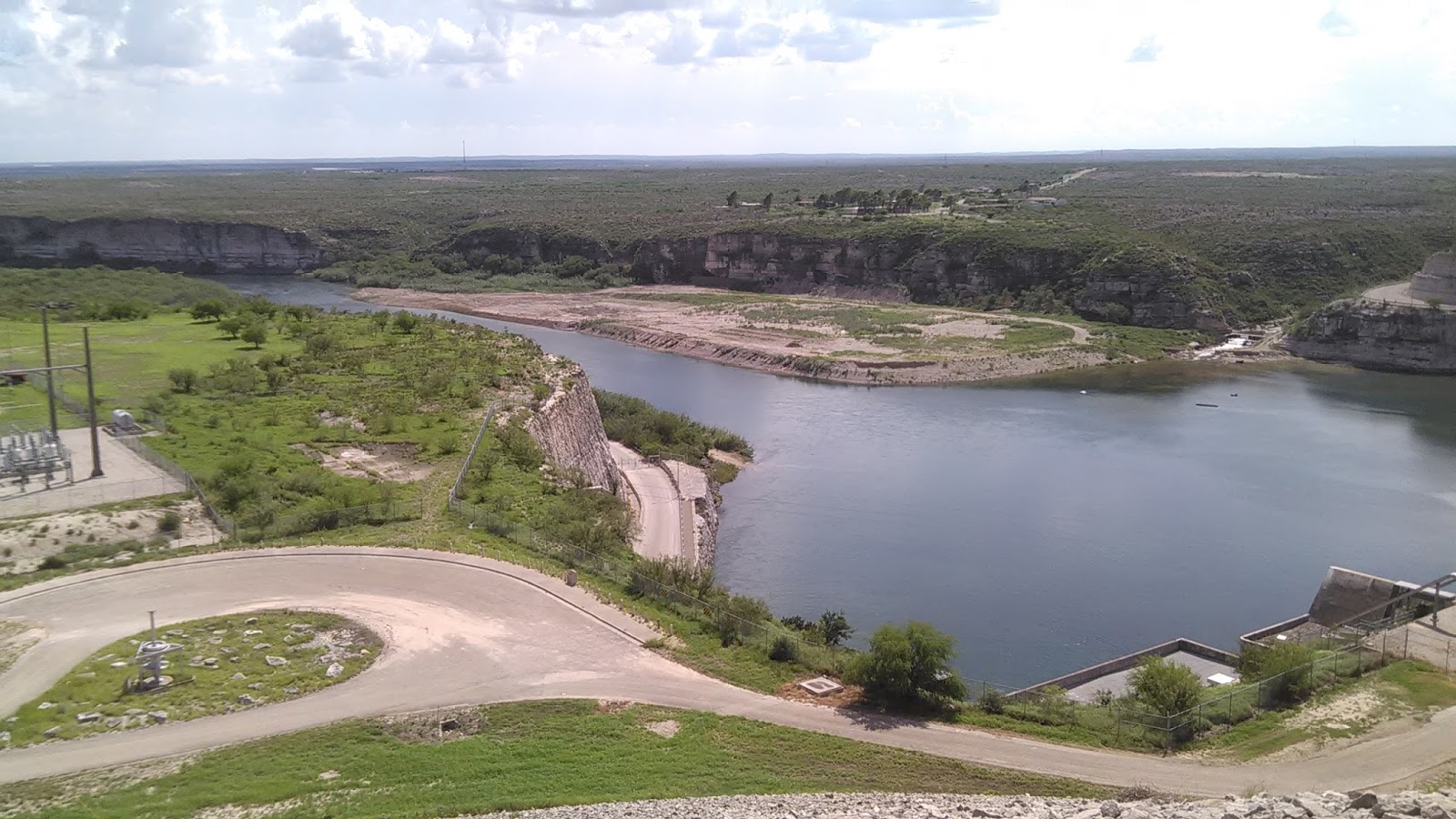
Tired, happy and full of new experiences (and food), we decided to head for home - come on Naggy, take us home please.  Guess what, we ended up going around in what seemed like circles again and ended up going out of town on the opposite side to where we came in - I could see on the map that she appeared to be taking us out to the Rio Grand and then back along it to the International bridge.  OK, lets see where she takes us now, we always enjoy the unexpected and the scenic route.  It turns out that there is another bridge and (according to the border patrol lady) GPS systems always seem to use that crossing.  That bridge was at the top of the Amistad Dam and what a sight it was, it is amazing - a very, very quiet road, beautiful border post and an awesome view down into the reservoir and the afterbay.  Yes, there is a reason for everything, especially for taking the scenic route and not sticking to the known or to convention :)

Judge for yourself - was it worth it?


Sunday, July 17, 2016

Progress - stop the multiplying

Well I think that we might finally have got into the depths of those dark recesses where all the multiplying has been taking place.  This weekend we got serious about getting items together to take to Colorado for Karen and Karl - now we have emptied the safe, shredded the contents, pictures are off the wall and some memories relinquished to recycle and garbage - the memories are stored in our minds, we don't need the weight of their physical storage.

The NuWave oven and Shark Steam Mop have been sold on Craig's List and even some spices and so on from the pantry have been put out to stock Karen's pantry.

Once all this has been moved out of the lounge into the car (is there going to be room for me ??) then we will be looking at a less stressful living environment.  The office is looking much clearer now and I can finally see that there is going to be room for the blow up mattress in there and the chance to turn it into a bedroom of sorts of Ian and Sian when they visit in a couple of months .. wow time is really passing, it is half way through July now so that means it is only 6 or 7 weeks until that amazing summer holiday that we have been planning all year. Although we are down sizing and getting rid of as much as possible, we bought a couple of new pillows yesterday - they were on sale at an amazing give-away price so at least Ian and Sian will have nice new pillows to rest their heads on.  Gerald gets through pillows a couple of times a year so these are not going to be wasted at all and with the compression bags that we got with our Amazon special purchase, they are going to squish up to next to nothing.

The closet in the bedroom is looking much emptier now and the closet in the office has enough room for Ian and Sian to put their clothes - not that we are going to be here much with the road trip to Las Vegas taking most of our time.

Yes, we are definitely beginning to see signs of getting there.

We are also thinking about taking a weekend to make a 'border run' during October or November - a trial run across the border into Mexico to see how it goes and prepare ourselves for the real thing.

Sunday, July 10, 2016

Update July 10th 2016

Some of our preparations are not planned and they are usually the ones that involve meeting people, striking up conversations about what we are going to be doing - they are the really fun ones!
The other day we were in our favorite local Jallisco tapateria and we were the only people eating there - we had a great conversation with Karla who works there.  She actually drives to her home in Manzanillo in the state of Colimo on the Pacific side of Mexico, twice a year.  Her journey usually takes her about 21 hours and she has no problems - of course the Mexican plates on her car and the fact that she is actually Mexican helps her a lot but still she has not encountered any of the bandits and tricksters that we are always being warned about by other tourists.  I have researched Manzanillo as well as the city of Chapala that she talked about and they are both very interesting places.  She did warn us not to linger in the small towns along the way - fill up and get going again - the cities are usually OK.

We have got excited about our journey again and some of the fear is waning again :)

We are also working again on clearing out things that we will not be able to (and not need to) take with us - Today (7/10/2016) we started working on the boxes and computers and so on in the office - this is two-fold, the stuff needs to go to new homes and we need the room to make a bedroom of sorts for Ian and Sian in less than two months.  Gerald is now so keen to sort this stuff out that he was awake at 5 this morning thinking about it and started working on sorting bits and pieces out in the office before 7 this morning - wow, this is getting intense!  Now we have 3 'piles' - for Karl, for Karen and for Salvation Army.  We still have a long way to go but we are beginning to see progress now - can't say the same for the living room with these piles of stuff !  The plan is to load up the car and drive to Colorado on 19th - wow less than 2 weeks away - the we have a day to visit Gerald's colleagues in Fort Collins, a day for Karen and Karl and then another 2 day drive to get home again.  We are really looking to the Colorado trip, not only for the ability hand over some items, but also just because it will be great to see the kids and even better to get away after the intense, stressful weeks that we have been spending working 60+ hrs a week under pressure.  Sure we will probably have to pay for it when we get back but it will be so nice to get away.

Our shopping list is also getting actioned, helped out a couple of days ago by selling the nu-wave oven and the steam mop - we used that money to buy some items that we will need to take with us.  So we ordered emergency triangles, red reflective tape, a bluetooth speaker (music is so important wherever we are going to be staying) and a few storage bags, the kind that you compress things in without using a vacuum cleaner or anything.  More progress !

Stay tune - this is all fun (stressful, painful at times but fun nonetheless).  We are getting even more in tune with each other and how to handle these situations, than ever before.  It is interesting how stressful situations can bring us even closer together - OK it doesn't start off that way - we stress, we get irritable but we draw breath, look at each other, smile with love, talk about it and just get closer.  It is wonderful to be able to pull together instead of pull apart.