Sunday, June 4, 2017

Palenque to San Cristobal

On May 29th we set out on Mex route 199 through the mountains from Palenque to San Cristobal for cooler (and hopefully drier) climes.
Google maps says 4 hr 34 min, it was more like 7 hrs but that's due to road construction and windy roads.
Our travels since April 1, 2017


There were a lot of new culverts being put in along the road, causing sudden rough patches and at one time we had to stop for a while so that they could finish covering one of the culverts enough for us to pass.


In general, the road was very rough for about 26 kilometers (to about Santa Maria)

Another reason we do not drive at night!  Notice that hole has been there a while since it has warning signs, several other similar holes didn't.  And its a deep one, as we passed we looked down on the tops of trees!


Having seen truck loads of some sort of fruit or something that we could not recognize, we figured it out when we saw palm fruit being harvested at the side of the road and mounds of the 'fruit' in other places (mostly alongside the road) ready for pick up by trucks.

Harvesting oil palm with a long pole beside the road.

Oil palm fruits

We then saw a huge bunker of this same 'fruit' and this prompted us to stop and find out what was going on - these are palma aceite (oil palms) used for extracting palm oil.  The worker that we asked said they are they used for 'food for cars' but we are not so sure as to whether or not they actually make car oil or bio-fuel from these or if they are used for the palm oil that we are all more familiar with from nutritional/culinary use to beauty products etc.  Palm oil plantations were created back in the '80s when the price of coffee and maize etc. dropped and peasants started leaving the lands and moving north and to USA etc.  They were told to start planting oil palm trees to make a living and they actually started getting paid a salary, this has meant that there are now areas that were high agriculture areas and are now reduced to oil palm trees.  However, we have also seen that a lot of palm plantations grow maize and other crops between the palms.  Another concern is the deforestation of the jungle to plant oil palms.

At Poblada Tulija the road was covered with limes which were just falling off trees onto the road. Remember all the recent news articles about how the price of limes is really going up?  Not here in Mexico - we have limes with everything.  You need to try squeezing some lime juice on eggs, it gives a whole new taste to everything.

As we got higher up into the mountains, the roadside vendor stalls disappeared and we were hounded by more aggressive sales techniques - ladies or children hung strings of flags across the road so that you could not pass until you had bought their bananas or whatever.  Somehow we managed to get past them but one little child walked right in front of our car as we were pulling away - once again, Gerald's amazing driving skills saved us from trouble.

No tope, so a rope will do.
You know you are far from civilization when there is no cell service, the taxis/collectivos have ham radio antennae and the gasolineria (gas station) is a bunch of plastic jugs on a shelf by the side of the road.  One gasolineria had 3 liter coke bottles filled with gasoline.  At least the jugs (pic below) look like polypropylene which  is safe for gasoline, I'm sure coke bottles (HDPE???) would slowly dissolve and can you imagine what that would do to your cars fuel injectors????
Rural Gas Station in the mountains.
We reached Ocosingo where it is about 4,000 feet elevation and it had cooled down (from high 90s) to a lovely 75F.
Leaving Ocosingo
About 14 miles after Ocosingo we came across our first scary 'situation' where some political activists were demanding donations for their party or candidates or whatever.  We didn't know what was happening at the time as we just came across a queue of vehicles - traffic stopped in both directions.  On the fence a way off the road were huge posters that we first thought were 'wanted' posters as they just had a person's face on each one - we found out later that these were obviously the political party candidates.  Several middle class looking people had thrown boards across with nails pointing upwards to prevent people from passing until they had put money into a tin.

Tire Spike board that gets pulled off by the rope, after you 'contribute'.
When it came to our turn at the board, a typewritten sheet of paper was thrust at us through the window and the tin was shown to us.  We realized that they were demanding money from us and they were taking a good look in the car (unfortunately I still had my camera on my lap).  It was obvious that they had seen the TX license plate and the TIP sticker prominently displayed on the windshield, they demanded 500 (quinciento) pesos from us and told them that we didn't understand what they wanted, why we should pay them and that we don't have that much money.  Somehow with our broken Spanish we got into quite a disagreement with them then decided to stick to English - we offered them 27 pesos which is all that we had in loose change in the car, but when they wouldn't back down we just went quiet and acted dumb.  I made a loud comment about it being OK, that the queue of traffic behind us was getting longer and that people were sure to get upset.  Finally they accepted our 27 pesos instead of the quinciento that they had been demanding.  We were very nervous for quite some time but have now realized that we were never really in any danger of any sort - we could have just handed over the money but we didn't see why we should have to pay more than everyone else just because we are gringos.  Another Mexican lifestyle lesson learned, in future we will just drop some coins into the tin like the locals do if we come across another situation like this.  We have also since learned that this route is the wild west of Mexico and that this sort of thing happens frequently here - the police will also just tell you to pay and pass.

We arrived in San Cristobal and after all the hot weather in Riviera Maya, it was 66 F (19 C), gray and rainy.  In three days we went from roasting to freezing.  It turns out that a large tropical depression is bearing down on the Puerto Escondido area (southwest of here on the coast) dumping tons of rain and May is the start of the rainy season with the forecast for the next 10+ days being rain.

Chetumal to Palenque

May 27, 2017
After our overnight stop in Chetumal, we set out along Mex 186 heading for a couple of days in Palenque. The roads were pretty good at this point and there was nothing much to report but we realized that we had not filled up before leaving Chetumal and would be needing gas somewhere along this 485 km road.  At Calakmul (235 km out of Chetumal) we came across a large Pemex (more likely to take our Visa card) and it had an Italian Coffee Company on site - we love being in the state of Campeche because that seems to be the center of Italian Coffee Company and their coffee is so good - we also finally got to try that pretty looking desert Gelatina de Mosaica (a mosaic of different colored jello blocks in a white gelatin desert).  We really enjoyed that treat and since we were the only people in the coffee shop we struck up a conversation with the two ladies working there and they told us (and showed us) what the white part of the desert is made from - basically it is a mix of condensed milk, evaporated milk and canned cream (when I said tres leches they laughed with me) and plain gelatin.  Hmm maybe we will try our hand at making some of this when we are in our Airbnb in San Cristobal for 16 days - would be a fun anniversary treat ;)

The town of Calakmul even has a bicycle path to it's outlying village and this is the first time that we have seen any bicycle paths.  The road so far has been really good all the way and we think that it must have been a toll road at one point.

Long straight road through the jungle, between Chicana and Escarcaga
Somewhere along the way we took another stop and finally got to try Pozol de Cacao - this is a traditional drink made from corn dough, water and cacao, all natural ingredients that have been used since ancient times.

At one place we came across a reduced speed limit because of bats but we were still going too fast for me to get my camera set to take a photo :(

We got stopped by a federal police officer at a tope and warned to slow down at topes (speed bump).  This was our first traffic stop and we feel lucky that this was not for a fine or anything.  I did wonder if the fact that I was busy taking a photo when were were stopped had anything to do with our easy getaway but we are pretty sure that it was genuinely just a warning and we need to stop being so blase about topes and speed limits and remember that the laws of the road may not appear to be adhered to and that even though they do not apply to taxis, we are more likely to get pulled up (especially now that we have the TIP sticker on the windshield glaringly advertising our status as tourists).  On the edge of Escarcega we got stopped again at another tope, this time by municipal police.  They wanted to know where we were going, are we from Texas and what is our nationality - really they just wanted to tease us telling us that we are those loco United States crazies.  We all laughed and were waved on our way.

Also around Escarcega, we started noticing that we were now in cattle country but that a lot of the cattle were really skinny.  There were also a lot of magnificent coral trees all along our route - the colors were really vivid.

Getting deeper into cattle country, the ranches were mixed with palm plantations but they were not coconut palms, they looked like date palms but we have not seen any dates here yet, maybe they were oil palms.  The terrain started getting even more arid even though we were now only about 40 miles from the coast- there were trees that looked like asparagus ferns.  That was the only place that we have ever seen them and there were not an awful lot of them even there.  When we stopped to take a closer look, they looked like some type of bamboo growing in tight clumps.

In general, the roads were more eventful today because we saw an accident between a collectivo and a car (there were a lot of police and we had to stop for a while) and shortly after that we saw a truck that had broken a drive shaft (I bet a tope caused it!), repairs were being carried out in the driving lane on the road.


Between Buena Vista and Chable, it has been 102 degrees F for a couple of hours now and here we saw a group of water buffalo cooling themselves in ponds and canals.

On the way into Palenque we saw lots of stalls with those beautiful dresses and blouses that are so popular around here - the locals actually do wear these colorfully embroidered clothes, they are not just for tourists to buy.


Once again, I got nervous when we started driving through narrow little streets that looked very local on the way to our hotel and wondered what I had booked us into - maybe I should stop looking for the cheapest hotels?  It turned out that this little hotel is an old colonial family home - yes it is in a narrow little street but they even have a very safe parking area across the street - a lot behind a huge solid steel door which only the hotel receptionist has a remote for.  This was great because we didn't have to unload everything, just our little suitcases and computer bags.

The cost for the hotel ($29 USD a night) included continental breakfast which was coffee, juice, toast, a fruit plate and some dry muesli which we think was to be eaten with the fruit - the first day (Sunday) we were surprised with a lovely little pancake but not the second day.

Posada (Inn) Aguila Real in Palenque


Friday, June 2, 2017

Palenque Maya Ruins

We visited the Palenque Ruins on May 28, 2017.  

The Palenque ruins are in the middle of a protected jungle zone which is home to Howler Monkeys. To get into the ruins you have to pay an ecological fee to help with the protection of the jungle and the Howler monkeys and then you pay the site fee once you get to the archaeological site.

Once inside, the beauty of the jungle surrounds you and you can constantly hear Howler monkeys near the entrance - I wish that we had caught site of them but they rarely come out where they are visible.

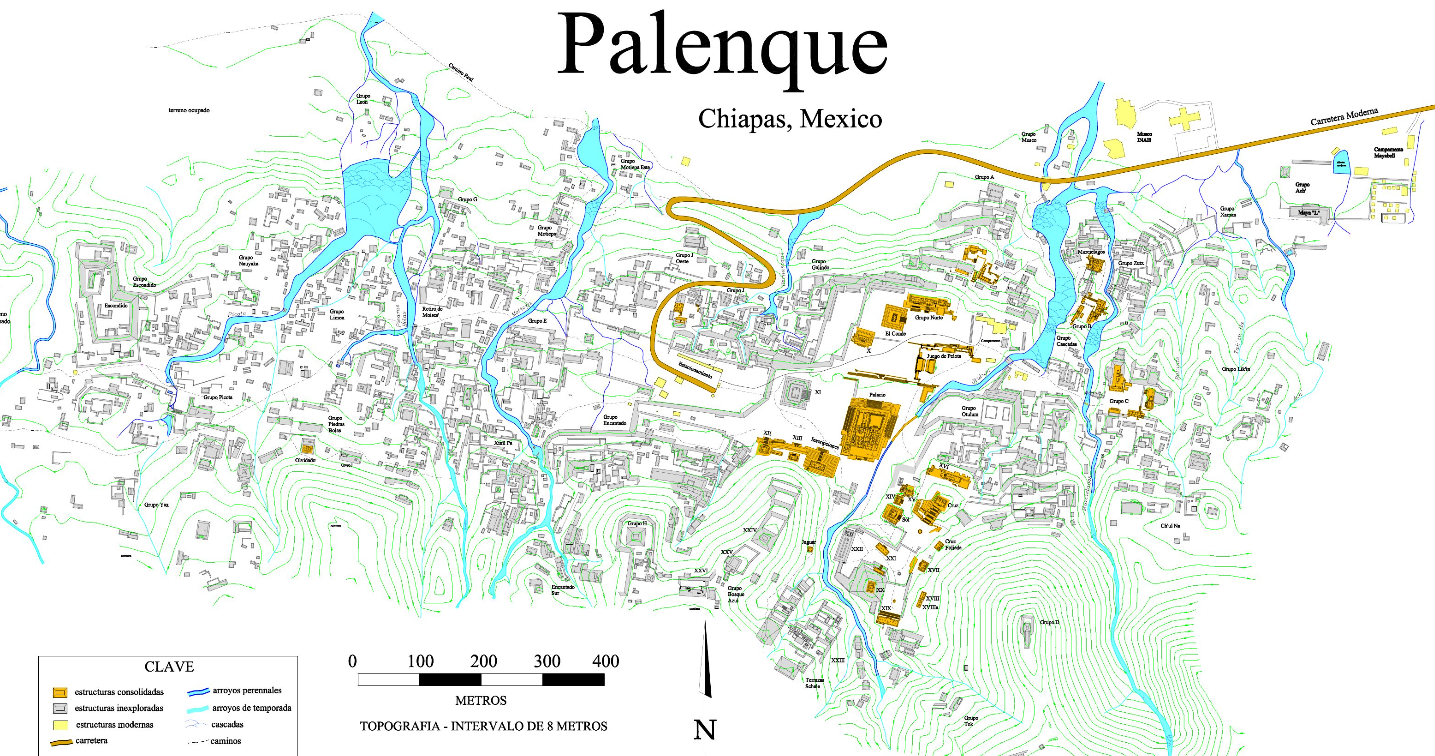
Only 5% of the ruins have been unearthed and the map below shows the restored ruins in yellow.  The large yellow block is the Palace and at 7 o'clock from that is the Temple of Inscriptions.  

Over the past 5 years or so, there has been some work on unearthing another temple directly in front of the Palace (10 o'clock) across the open area.  But there have been issues with the environmentalists as they do not want the trees cut down.  Since both sides (archaeologists and environmentalists) are at a dead lock and ground penetrating radar shows some empty chambers, no tombs, it is unlikely that work will continue.

As of this writing, you can still climb on some of the pyramids but rumor has it that all pyramids will be off limits by year end due to lawsuits from US insurance companies over tourists falling down the steps and getting seriously hurt.  A couple years ago Ernesto (our guide) witnessed a tourist fall while trying to take a picture and climb the steps.  The person tumbled down most of the steps on the Palace and was seriously hurt, ending up in a wheel chair. In Mexico, you are responsible for your actions and it appears the USA lawyers motto of "someone else is always responsible for your stupidity" is reaching Mexico.

For the first time we hired a guide.  His name was Ernesto and he spoke very good English.  A young couple (Jon and Megan) from England/Australia were on a limited budget and were looking for some other people to share the guide cost with.  So for 400 pesos (US$22) Rosalind and I signed up for the guided tour.  After we parked the car, all the guides were trying to get our attention with "guide for 100 dollar, guide for 95 dollar" etc. so we were really lucky to get a wonderful and very knowledgeable guide for such a cheap price.  The tour was supposed to be 90 minutes but ended up being well over 2 hours.  I think Ernesto enjoyed us as well since all of us were asking lots of questions and he provided great answers.  He mentioned giving a tour to a VIP  once that only asked one question as he got into the limo at the end.

The Palenque site started about 266 BC, flourished in the seventh century and was active until approximately 799 AD.  


Edzna stone work
Palenque stone work
Palenque doesn't have the close fitting stonework that Edzna has but Edzna was active from 400 BC until 1500 AD.  It appears in those later 700 years, the workers of Edzna had perfected their masonry skills as the stone work was much more precise and close fitting.


Per Ernesto, the international Archaeologists (they meet in Palenque every 2 yrs) did a field test of creating the cement (from limestone) used to mortar the stones together.  They used the ancient techniques and discovered it takes 40 kg of wood to create 1 kg of cement.  And to build these huge pyramids, it takes a lot of cement. Some quick calculations revealed that the Mayas likely deforested much of the Yucatan peninsula in the pursuit of  wood for kilning the limestone, cooking and building wood structures.  Maybe this had an influence on the fall of the Maya city-states.  Also as resources became sparse (food, water, timber etc) once friendly neighbors became hostile.  The Maya were a peaceful people only resorting to war in dire circumstances.  

The tomb of the Red Queen was proof that ancient Maya culture was matriarchal.  

Temple of Inscriptions (left), temple of the Red Queen (center), temple of the Skull (right)
Carving from Temple of the Skull

In Temple of the Red Queen you can go inside the pyramid to view 3 chambers.   
Inside a chamber in Temple of the Red Queen
Temple of the Red Queen steps leading to a blocked passageway.

Sarcophagus of the Red Queen in the museum at the bottom of the hill.

Standing on the Palace with the Temple of Inscriptions behind.
The Palace
The most unusual and recognizable feature of the Palace is the four-story tower known as The Observation Tower. The Observation Tower like many other buildings at the site exhibit a mansard-like roof. The Palace had many large baths and saunas which were supplied with fresh water by an intricate water system. We have seen this type of water system in several other Mayan archaeological sites. An aqueduct, constructed of great stone blocks with a three-meter-high vault, diverts the Otulum River to flow underneath the main plaza. The Palace is the largest building complex in Palenque measuring 97 meters by 73 meters at its base.
The Palace today

Reconstruction model of the Palace.  (from wikipedia)


Temple of the Sun (left).  Notice the stone roof comb on the top.
Another roof comb.


Ernesto explained roof comb lattice work on top of the buildings. You will notice them all around the outer edge on the Palace in the reconstruction model above.  It is required to add weight to the center parts of the Corbel Arches. From Wikipedia:
The A-shaped Corbel arch is an architectural motif observed throughout the complex. The Corbel arches require a large amount of masonry mass and are limited to a small dimensional ratio of width to height providing the characteristic high ceilings and narrow passageways. 
The extra mass of the roof comb makes the arch more stable and likely why many of the arches have survived over a 1000 years.  The roof combs were made of open stone lattice work to allow the wind to pass through and not blow over during hurricanes etc.  He drew a sketch showing the cross section of how twin arches are made shown here.


Opening in center arch possibly to save weight and materials.
Arch in the Palace (opposite the Hall of Portraits) showing the massive size and the collapse of  part of the right side of the arch.  The center (left side) remains intact.
Hall of Portraits.  Ernesto (white cap) is talking to Jon and Megan.
Original Portrait in Hall of Portraits
Another original Portrait in Hall of Portraits.  Amazing that the pigment has survived over 1,100 years.

Some original artwork has survived all the years.
Look at the edges of the opening, the plaster is about 2 inches thick and yes black mold is a problem with leaky limestone blocks.
Original artwork in the plaster (left side of opening from above picture).
Artwork around an opening.


The Palace has two toilets!  Now that is a cold hard toilet seat!  (the original long drop toilet?)

Temple of the Cross (left) and Temple of the Sun (right).  The forested hill behind has another buried temple on top of it.


Curse of the Tombs
The two primary colors used by the Mayans were red and indigo blue.  To make the red pigment they used mercury which was likely fatal to the workers after years of exposure.  We have all heard of the curse of the mummy right?  Back before people realized the dangers of mercury and days of tomb raiders, they would open a tomb chamber that had been sealed for thousands of years and all the stucco with red and blue pigments would out-gas mercury to be inhaled.  Recent tomb openings have shown very high levels of mercury and the archaeologists always use respirators now to protect themselves.

Museum
At the base of the hill is a Museum that houses artifacts found at the site including the Red Queens sarcophagus.  If you walk down following the trail you pass the Queens Bath waterfall.  We were told that this is another sign that there was a matriarchal society during this time, as the Queen had a bath.

Queens Bath

Bridge across the stream below Queens Bath
And more structures along the way.


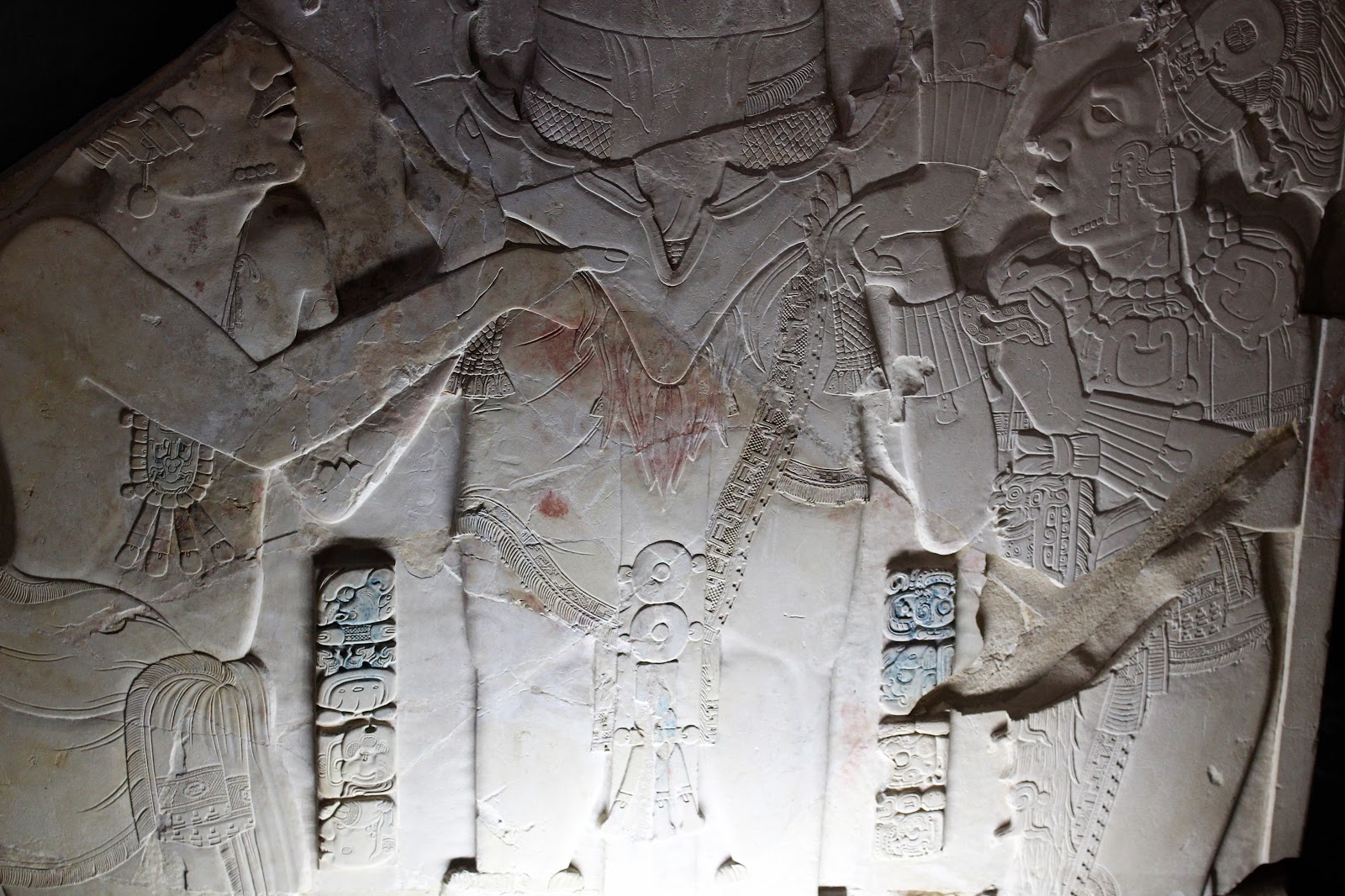
Following are some pictures from the museum.


Locals
The Maya culture is still strong in this part of Mexico.  A whole bus load of school kids were touring with their traditional Mayan dress.


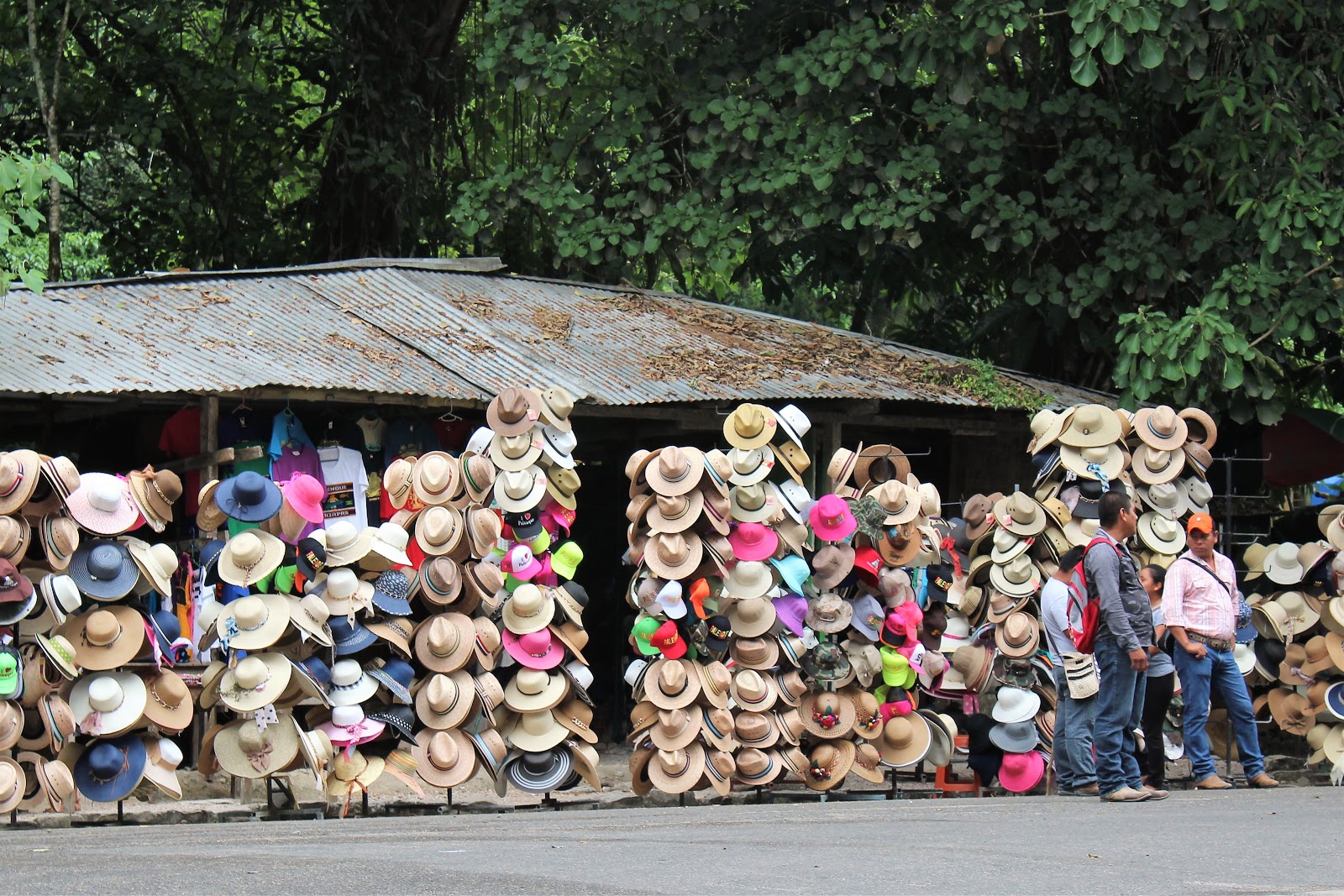
And of course there were the local vendors selling their wares inside and outside the ruins.  One of my favorites was the Jaguar growler, it sounded just like a Jaguar and all they did was blow into it.  And there were howler monkeys making all sorts of noise also, so it was quite an experience.

Vendor stall by the parking lot


This sensitivity plant grows throughout the ruins in the grass.  You touch the serrated leaves and they close up quickly (within a second or two)!